
Table of Contents
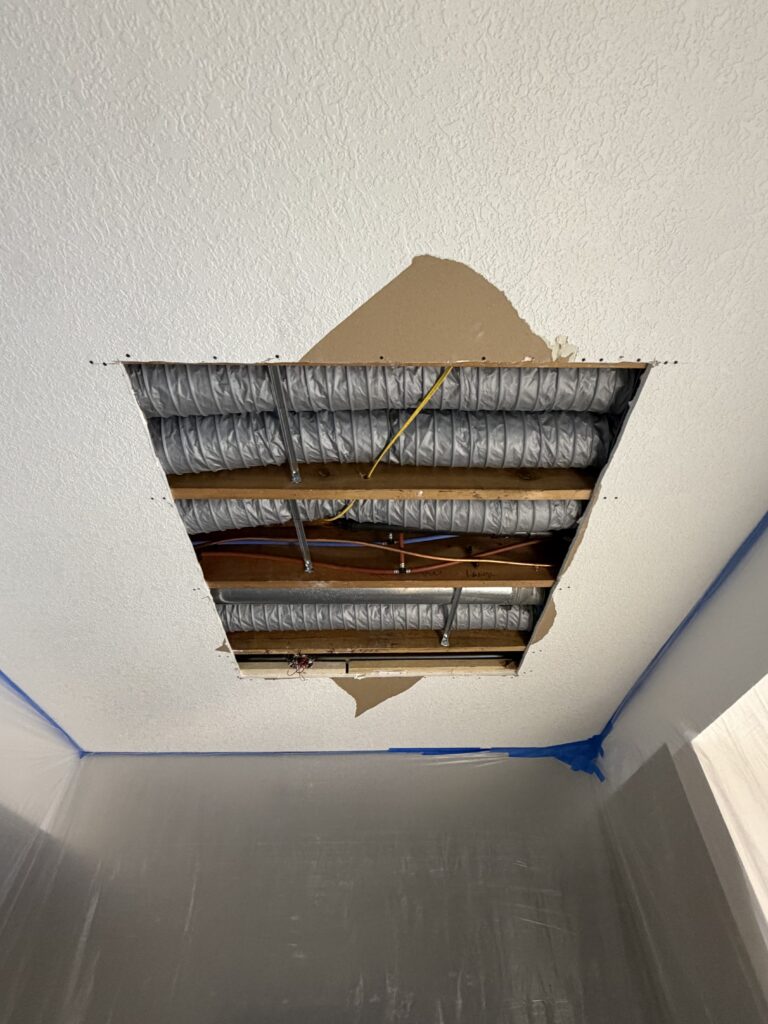
Water-damaged drywall should generally be replaced when it is soft, swollen, sagging, crumbling, delaminated, mold-affected, or no longer securely attached. A light stain on drywall that remained firm and dried completely may not always require full replacement, but the source of the water must be fixed and the area properly evaluated before it is sealed or painted.
The visible stain is only one part of the problem. The condition of the drywall core, insulation, framing cavity, fasteners, texture, and material behind the surface all help determine whether the area can be retained or must be cut out.
Fix the leak before repairing the drywall
Drywall repair should not begin while water is still entering the wall or ceiling.
The first step is to identify and correct the source, which may involve:
- A roof leak
- An ice-dam-related leak
- A plumbing supply line
- A drain or fixture leak
- A leaking appliance
- Window or exterior flashing
- Condensation
- Water entering through a foundation or basement assembly
A drywall contractor repairs the damaged finish. The appropriate roofer, plumber, restoration professional, exterior contractor, or other specialist may need to correct the underlying source first.
Replacing drywall before stopping the leak usually leads to another damaged ceiling or wall.
When does water-damaged drywall need replacement?
Replacement is usually the safer and more durable option when the drywall has lost its strength, shape, bond, or clean condition.
The drywall is soft
Drywall that feels soft, spongy, or easily indented has likely lost integrity. Even if it dries, the gypsum core may remain weakened.
Do not repeatedly press on a sagging ceiling to test it. A severely damaged section may release material or come down unexpectedly.
The ceiling is sagging or bulging
Sagging indicates that the panel or its paper face has been compromised, the fasteners are no longer holding correctly, or water has collected above the surface.
A bulging ceiling is not a cosmetic paint problem. The affected area should be evaluated promptly, and people should avoid standing underneath visibly unstable material.
The surface is swollen or warped
Wet drywall can change thickness or shape. Swollen edges, ripples, raised seams, and warped panels generally do not return to a clean, flat condition just because the area dries.
The paper face is peeling or bubbling
Drywall depends on its paper facing for strength and finishing. When the paper separates, bubbles, tears, or peels away, simply coating over it can leave an unstable surface.
The material is crumbling
Chalky, flaking, or crumbling drywall should be removed back to solid material. Joint compound and paint cannot restore a deteriorated core.
The drywall has been wet for an unknown period
A slow leak can remain hidden long before a stain appears. When the duration is unknown, opening the area may be necessary to inspect the cavity and determine how far the damage extends.
There is suspected mold growth
Visible spotting, musty odors, or growth inside a wall or ceiling cavity may require assessment and remediation beyond an ordinary drywall patch.
The source of moisture must be corrected, affected materials must be handled appropriately, and the cavity should be ready for reconstruction before new drywall is installed. Drywall replacement should not be used to conceal unresolved growth.
The water was contaminated
Water from a clean plumbing source presents a different situation from water involving sewage, drain backups, floodwater, or other contamination. Contaminated porous building materials may need specialized removal and cleaning.
A restoration or environmental professional should determine the appropriate response when contamination is possible.
Wet insulation or cavity material must be removed
Sometimes the drywall must be opened even when its face does not look severely damaged. Wet insulation, trapped moisture, damaged vapor-control materials, or hidden debris may require access to the cavity.
When might drywall be repairable without full replacement?
A minor water stain does not always mean the entire panel must come out.
The drywall may sometimes remain when:
- The water source was corrected quickly.
- The material dried completely.
- The panel remains flat and firm.
- The paper face is fully bonded.
- There is no sagging, swelling, crumbling, or softness.
- There is no indication of hidden moisture or mold.
- The cavity does not need to be opened.
- A knowledgeable professional determines that the material is still sound.
Even then, the stain may require proper surface preparation and a stain-blocking primer before finish paint. Ordinary wall paint alone may allow discoloration to bleed back through.
The key question is not whether the stain can be hidden. It is whether the drywall and the materials behind it remain sound and dry.
Why painting over a water stain is not a complete repair
Painting may improve the appearance temporarily, but it does not:
- Stop the leak
- Dry wet insulation
- Restore weakened drywall
- Reattach separated paper
- Flatten a swollen panel
- Remove contaminated material
- Correct a sagging ceiling
- Investigate mold inside the cavity
A stain can also return through fresh paint when the surface is not prepared correctly.
Painting is the final cosmetic step after the moisture source and material condition have been addressed. It should not be the first or only response.
How a drywall contractor determines how much to remove
The objective is not necessarily to replace an entire wall or ceiling. It is to remove enough material to reach sound, dry drywall and create a repair that can be securely installed and cleanly finished.
A contractor may consider:
- Where the drywall becomes firm and undamaged
- The location of studs, joists, or backing
- The shape of the damaged area
- Whether insulation or framing needs access
- Existing seams and corners
- Ceiling texture
- Nearby fixtures, vents, cabinets, and trim
- Whether the patch can be fastened securely
- How the repair will blend into surrounding surfaces
Superior Drywall’s water-damage repair process involves cutting back to solid, dry material, installing new drywall, taping and finishing it, and matching the surrounding texture so the repaired area blends into the room.
What happens during water-damage drywall repair?
Every project is different, but a typical drywall phase follows a clear sequence.
1. The water source is corrected
The responsible trade stops the roof, plumbing, appliance, exterior, or drainage problem.
2. The area is evaluated and dried
Wet materials are identified, and the assembly is allowed or professionally assisted to dry as appropriate. A restoration specialist may be involved when the water event is extensive.
3. Compromised drywall is removed
Soft, sagging, swollen, contaminated, or otherwise unsound material is cut out. Removal continues until the remaining edges are suitable for reconstruction.
4. The cavity is addressed
Insulation, framing, or other concealed materials can be inspected and handled by the proper trade. New drywall should not close a cavity that is still wet or contains an unresolved problem.
5. New drywall is installed
Replacement material is cut and securely fastened, with appropriate backing where needed.
6. Joints and fasteners are finished
Tape and joint compound are applied in multiple steps to blend the new panel into the existing wall or ceiling.
7. The surrounding texture is matched
A successful repair should not leave an obvious smooth rectangle in the middle of a textured surface. Matching may involve knockdown, orange peel, or another existing finish.
8. The surface is prepared for paint
After the compound and texture are complete, the area is left ready for the appropriate primer and finish coating. Painting a broader section may sometimes produce a more uniform visual result than touching up only the patch.
Can wet drywall dry out on its own?
Some limited moisture exposure may dry without destroying the panel, but appearance alone does not prove that the assembly is dry.
Drying conditions depend on:
- The amount of water
- How long the material was wet
- Whether the cavity is open
- Air movement
- Temperature and humidity
- Insulation
- The type of paint or wall covering
- Whether moisture is trapped between layers
- The cleanliness of the water source
A wall can feel dry at the surface while moisture remains behind it. When the leak was substantial, hidden, prolonged, or repeated, professional moisture evaluation may be appropriate.
How long should you wait before repairing drywall?
There is no responsible one-size-fits-all waiting period.
Repair can proceed when:
- The water source has been corrected.
- Materials that will remain are dry.
- Any required restoration or remediation is complete.
- The cavity is ready to be closed.
- The repair scope is understood.
Starting too soon can trap moisture. Waiting unnecessarily after everything is dry can leave the home open and disrupted longer than needed. The condition of the assembly, not a generic number of days, should control the schedule.
What about a water stain caused by an ice dam?
Minnesota winters can create ceiling damage when roof conditions allow water to work beneath the roofing system and enter the home.
Drywall repair should follow the same basic order:
- Address the roof or ice-dam-related source.
- Determine whether insulation or other materials became wet.
- Dry and inspect the affected assembly.
- Remove unsound ceiling drywall.
- Install and finish the replacement.
- Match the surrounding ceiling texture.
- Prime and paint appropriately.
The drywall patch corrects the interior damage, but it does not correct the roof condition that caused it.
Does a small ceiling stain mean a large repair?
Not necessarily.
Water can travel along framing, pipes, fasteners, or the top of a ceiling before appearing at a low point. A small visible stain can come from a limited event, or it can be the only visible sign of a larger hidden issue.
Conversely, a broad stain does not always mean the entire ceiling must be replaced. Once the source is fixed and the assembly is evaluated, the repair can often be limited to the material that is actually compromised.
A well-planned repair balances two goals:
- Do not leave weakened or affected material behind.
- Do not remove sound material without a reason.
Can the ceiling texture be matched?
In many cases, yes.
Texture matching requires more than spraying material onto the patch. The contractor must account for:
- Texture type
- Pattern size
- Density
- Application method
- Previous coats of paint
- Age and wear
- The transition around the repair
- Lighting across the ceiling
An exact microscopic match is not always realistic on an older, repeatedly painted surface. However, careful feathering and application can make the repair blend naturally enough that it does not draw attention after painting.
For extensive damage, refinishing or retexturing a larger section may sometimes create a more consistent appearance.
Should you replace the entire ceiling?
Full ceiling replacement may be worth considering when:
- Damage is widespread.
- Multiple areas are sagging or compromised.
- Several old repairs already exist.
- The ceiling texture is difficult to blend across numerous patches.
- The homeowner also wants to remove dated popcorn texture.
- The underlying finish is poor throughout the room.
- Access is needed across a large part of the ceiling.
A localized leak usually does not automatically require a full replacement. The contractor should explain why a patch, larger sectional repair, or complete ceiling replacement is being recommended.
What should a water-damage drywall estimate include?
The proposal should describe the actual construction scope.
Look for clarification on:
- Which drywall will be removed
- Whether demolition and disposal are included
- Whether insulation or mold work is included or excluded
- Installation of replacement drywall
- Backing or framing needed for the patch
- Taping, mudding, and sanding
- Texture matching
- Dust and room protection
- Cleanup
- Primer and painting
- Work around fixtures, cabinets, or trim
- Responsibility for correcting the leak
- What happens if additional hidden damage is found
Superior Drywall provides detailed proposals tailored to the project. Clear exclusions are just as important as included work because water-damage repairs can involve several different trades.
Who should you call first?
The right first call depends on the active problem.
- Water is still entering through the roof: Call a roofer or emergency mitigation provider.
- A plumbing line is leaking: Shut off the appropriate water supply when safe and call a plumber.
- There is standing water or broad saturation: Contact a water-mitigation or restoration professional.
- There may be mold or contaminated water: Contact the appropriate remediation or environmental professional.
- The source has been corrected and damaged drywall remains: Call a drywall repair contractor.
- The damage is part of an insurance claim: Document the condition and follow the insurer’s reporting instructions while taking reasonable steps to prevent further damage.
Superior Drywall focuses on removing and rebuilding damaged drywall, restoring the finish, and matching the surrounding texture once the site is ready for drywall work.
Water-damage drywall repair in the Twin Cities
Leaks, plumbing failures, condensation, and winter roof problems can affect homes throughout the Twin Cities metro.
Superior Drywall serves homeowners in Forest Lake, Blaine, Maple Grove, Plymouth, Elk River, and communities within approximately 50 miles of Wyoming, Minnesota.
Whether the damage is a small ceiling opening after a plumbing repair or a larger section that must be cut back to sound material, the goal is the same: rebuild the area correctly and leave the wall or ceiling looking complete again.
Request a free drywall repair estimate
Once the leak has been stopped and the area is ready for reconstruction, Superior Drywall can remove compromised drywall, install replacement material, finish the joints, match the surrounding texture, and prepare the surface for paint.
Contact Superior Drywall to request a free estimate for water-damage drywall repair in the Twin Cities metro.