
Table of Contents
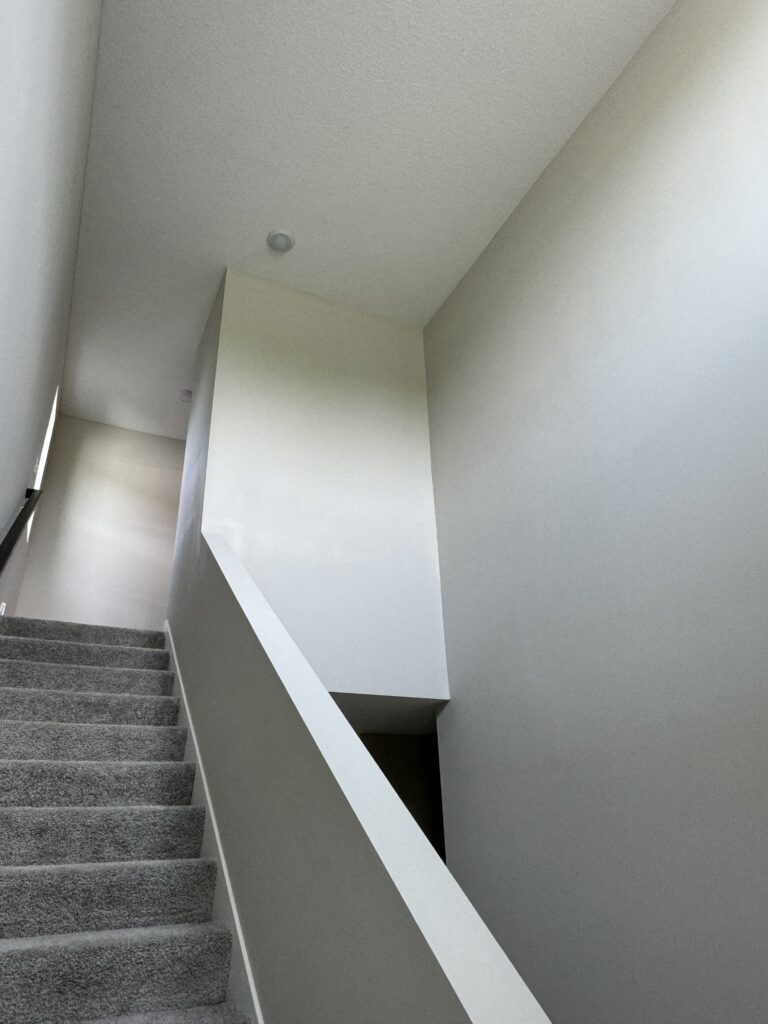
If you have a crack where an interior wall meets the ceiling, and it opens up every winter and closes again by summer, your house is almost certainly fine and your drywall work was probably fine too.
What you are looking at is most likely truss uplift. It is a seasonal movement in the roof trusses above that lifts the ceiling slightly away from the wall below, and it is one of the few drywall problems where mudding it again every spring is guaranteed not to work.
Here is how to tell truss uplift from the cracks that mean something else, and what actually stops it.
The tell: it comes and goes with the seasons
Truss uplift has a signature that nothing else has.
- The gap appears in cold weather and closes when the weather warms
- It shows up along the top of interior walls, the partition walls inside the house, not the exterior walls
- It is often widest in the middle of a wall and tapers toward the corners
- It comes back in the same place after being repaired, usually the first winter after the repair
If that describes your crack, keep reading. If your crack is in a different place or does not move with the seasons, skip to the section on other cracks.
What is actually happening above your ceiling
Your roof is probably framed with trusses rather than rafters. A truss is a triangle: top chords following the roof slope, a bottom chord running flat across, and webbing between them. Your ceiling drywall is attached to the bottom chord.
Those chords live in very different conditions. The top chords sit up in a cold, dry, ventilated attic. The bottom chord is buried in insulation, with warm household air underneath it. In a Minnesota winter that difference is dramatic, and because wood moves as its moisture content changes, the chords change length by different amounts.
The result is that the bottom chord arches upward in the middle. The published explanation is straightforward: a truss exposed to changing moisture and temperature conditions arches up in the center, and the ceiling drywall fastened to it moves with it. The ceiling lifts away from the top of the interior partition wall, and a gap opens along that joint. When conditions even out in warmer weather, the truss settles back and the gap closes.
That is also why it is interior walls and not exterior ones. Exterior walls carry the ends of the truss, which are not going anywhere. Interior partitions just happen to be standing under the part of the truss that moves.
This is not a foundation problem, and it is not a structural failure. The truss is doing what wood does. We do not do foundation or structural work, so if anything you have been told points that direction, get a second opinion from someone who does. But a seasonal gap at the top of an interior wall, opening in winter and closing in summer, is a well-documented wood movement issue.
Why re-mudding it never holds
Because the movement is still happening. Compound and tape are rigid once dry. Put a rigid repair across a joint that moves a measurable amount twice a year and it cracks again on the next cycle. Sometimes in the same winter.
This is the part worth understanding before you pay anyone to fix it. A contractor who just tapes and muds it again is not ripping you off, but they are selling you an annual appointment. The repairs that actually last all work the same way: they stop fighting the movement and either hide it or let the drywall move freely.
What actually works
Three approaches, in order of how disruptive they are.
Crown molding, fastened to the ceiling only
The practical fix for most finished homes, and the one most often recommended.
Crown molding is installed at the wall-ceiling joint but fastened only into the ceiling, not into the wall. When the ceiling lifts, the molding rides up with it and the joint behind it stays covered. The gap still opens, you just never see it.
One detail that matters: paint the wall behind where the molding will sit before installing it. If you do not, the ceiling lifts in winter and exposes a stripe of unpainted wall under the trim.
Freeing the drywall from the truss
The more thorough repair. The ceiling drywall near the interior partitions gets released from the bottom chord of the truss, so the drywall is supported by framing that is not moving and the ceiling can flex instead of being dragged upward right at the wall.
In practice that means removing the ceiling fasteners near the partition corners and the wall fasteners near the ceiling, then patching, taping and repainting. It is effective and it is also, as the trade literature puts it plainly, time consuming and costly. It is a real repair, not a quick one.
In new construction or a remodel, build for it
If walls are open, this gets solved before there is anything to crack. Two standard methods: truss clips, which fasten to the top of the interior partition and allow the truss to move vertically in a slot, and a floating interior corner, where the ceiling and wall drywall are joined to each other with a backing angle but deliberately not fastened into the bottom of the trusses.
There is also a longer-term option: a conditioned attic, insulated against the roof deck rather than at the ceiling, which reduces the difference between the chords and therefore the movement. That is an insulation and ventilation project rather than a drywall one, but it is worth knowing it exists if you are already considering it.
If you are planning a remodel or addition, this is the cheap moment to handle it.
Cracks that are not truss uplift
Not every crack is seasonal. Here is how the others read.
Hairline cracks over doors and windows
Very common and usually benign. The drywall above an opening is a short, narrow strip with a joint near the corner, and normal settling and seasonal movement concentrate stress right there. These take a normal repair and generally stay fixed.
Straight cracks following a seam
A line running the length of a wall or ceiling in a dead-straight path is a drywall joint that failed, often because the tape was not fully bedded in compound and a void let it lift. The fix is cutting out the bad tape, re-taping and re-coating. This one stays fixed when it is done properly.
Small round bumps or pops in a line
Nail pops or screw pops. The fastener has backed out slightly, or the framing shrank around it, and it pushed the compound off. Individually trivial, and when they are all along one line it points at that framing member. Repair is to drive a new fastener nearby, remove or reset the popped one, and re-coat.
Cracks with a brown or yellow stain
That is water, not movement, and the order of operations matters. The leak gets fixed first by whoever handles leaks, then the drywall gets repaired. We do the drywall side. Water-damaged drywall covers how to tell what is salvageable, and water damage repair covers the repair.
Stair-step cracks in a basement wall, or cracks with doors suddenly sticking
Different category entirely, and not ours. Diagonal stair-step cracking, especially in a foundation wall, or cracks that arrive alongside sticking doors and sloping floors, is a question for a structural engineer or a foundation contractor, not a drywall company. We would rather tell you that than take the job.
What we do about it
We repair, tape, texture and finish drywall, including the crown molding approach and the full release-and-retape repair on ceiling and wall joints. We take small repairs, so one crack is a call worth making.
What we will not do is tape over a seasonal crack, call it fixed, and let you find out next February. If what you have got is truss uplift, we will say so and walk you through which of the options above fits your house and your budget.
Drywall, sheetrock, gypsum board: same thing, and we hang, tape and finish all of it. Drywall repair covers the broader repair work, and if the room needs paint after a ceiling repair we handle that too at interior painting.
We work across the north Twin Cities metro, including Forest Lake, Blaine, Elk River, Maple Grove, Plymouth, Hugo and Coon Rapids.
Ceiling crack questions
Is a crack between the wall and ceiling serious?
A gap at the top of an interior wall that opens in winter and closes in summer is usually truss uplift, a seasonal wood movement issue rather than a structural one. Cracks that come with sticking doors, sloping floors, or stair-step cracking in a foundation wall are a different question and belong with a structural professional.
Why does my ceiling crack come back every winter?
Because the movement causing it happens every winter. Joint compound and tape are rigid, so a rigid repair across a joint that moves seasonally will crack again on the next cycle.
Can truss uplift be fixed permanently?
The movement itself generally cannot be stopped in a finished house without significant work. What can be fixed permanently is the visible crack, either by covering the joint with crown molding fastened only to the ceiling, or by releasing the ceiling drywall from the trusses near the interior walls so it can move without cracking.
Why does it only happen on my interior walls?
Exterior walls support the ends of the trusses, which do not move much. Interior partition walls sit under the middle of the truss, which is the part that arches.
What are the small round bumps in my ceiling?
Those are nail or screw pops: a fastener backed out slightly and pushed the compound off the surface. They are cosmetic and they repair easily.
Do you repair plaster ceilings?
We do drywall. Genuine plaster needs a plaster specialist.
Want someone to look at it?
Send a photo of the crack and tell us whether it changes with the seasons. That one detail usually tells us what we are dealing with before we even come out.
Estimates are $25 on site, credited toward the project when you hire us. For a crack like this that is time well spent, because the right repair depends on what is actually moving.
Superior Drywall is based in Wyoming, MN. Call 763-501-9571 or get an estimate. Monday through Saturday, 7am to 7pm, 60+ five-star reviews on Google.